Customer Spotlight: An Interview with Ginny Herzog

This post is part of our ongoing series highlighting the work, expertise, and creative practices of Metropolitan Picture Framing customers.

I create geometric mixed-media abstractions in oil, cold wax, and architectural collage, working exclusively on Ampersand’s Gessobord panels. My larger pieces are typically done on flat panels, while the smaller works are created on cradled panels.
Each painting begins with collage. Over the years I’ve photographed thousands of architectural details, which I digitally manipulate in Photoshop and print as laser color copies. I cut these images apart and reassemble them into new architectural forms—structures that don’t actually exist. Orientation doesn’t matter; I treat the fragments as building blocks rather than literal references. Once the composition feels resolved, the collage elements are carefully adhered to the panel with acrylic matte medium.
I then begin applying layers of oil paint mixed 50/50 with cold wax medium. Using silicone spreaders, brayers, crumpled paper, plastic bags, and other unconventional tools, I build up the surface in multiple layers. I often alternate complementary colors, and opaque with transparent passages, to suggest the visual qualities of building materials—concrete, plaster, granite, weathered metal, and architectural patinas. Textured materials such as crack stop, stencils, corrugated paper add additional dimension, and I sometimes incorporate charcoal powder, marble dust, or dry pigments into the mixture for further depth.
The work develops in stages, with drying time between each layer. When the surface has set up but is not fully cured, I add linear detail using graphite pencils, oil sticks, and watercolor crayons. Throughout the process I continually rotate the panel, as each piece is designed to be oriented either vertically or horizontally.

What led you to start using Metropolitan frames?
About thirty years ago, I was looking for a new frame profile for my paintings. Another artist suggested I contact Metropolitan because they designed their own contemporary profiles. I brought one of my architectural paintings to Les, the co-owner of the business, and explained what I needed: a clean, simple frame in which the flat panel could sit back slightly and appear to float. I also needed a durable finish because I was traveling around the country doing art fairs, transporting my paintings separated with foam core inside crates. This system allowed me to move the work efficiently without individually wrapping or boxing each piece—saving time and space. It also made it easy to slide out individual paintings when visiting collectors.
Les developed the 122 profile to meet these needs, and I’ve used it ever since. My choice is the clear maple with the black interior finish.
My architect collectors and other clients greatly appreciate the exceptional quality and craftsmanship of Metropolitan frames.

Note: this profile comes in different depths to accommodate 3/4 - 1/1/2" panels or stretcher bars.
Do you typically place your orders online or by phone?
I usually email Adrienne with the panel sizes—I work with six standard sizes—and she enters the order details for me.
Do you order joined frames or cut-to-size with wedges?
I have the frames assembled for pickup, since I live only about 15 minutes from their facility. (Note: we have a framing advice section that details all aspects of framing for customers who prefer to order unjoined frames with wedges to save on shipping costs.)
How have you set up your studio for framing? Any tips you think other artists would appreciate?
I do all of my framing on my kitchen island or dining table in my townhome, since I don’t have a workshop and my studio isn’t large enough to accommodate a dedicated framing area.
How do you market your work?
For fifty years, I successfully marketed my work at outdoor art fairs across 25 states.
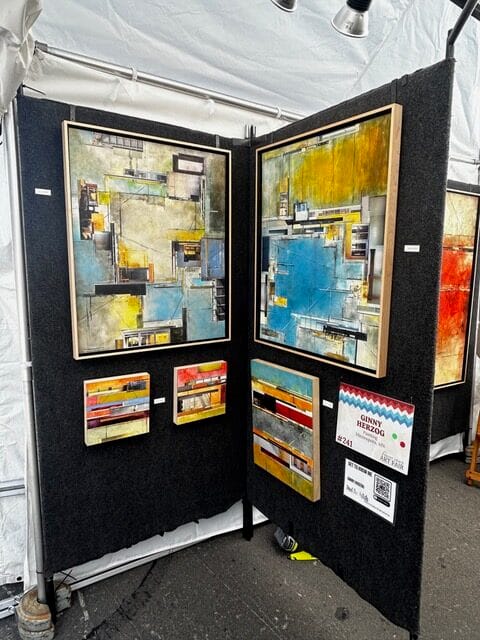
This past September, I participated in my final art fair and have since stopped traveling to market my work. I now focus on reaching my audience through my extensive email list of more than 2,500 customers. Using Constant Contact, I share new work as it becomes available on my website, which I keep updated regularly. Because of my distinctive style and architectural subject matter, I developed a large base of loyal collectors—many of them architects. I also complete a significant amount of commission work, often site-specific, and I believe I may be the only artist creating this particular type of architectural commission for clients.

How do you price your artwork?
I price my work according to size. My current mathematical formula is based upon multiplying the dimensions (W x L) x 3. Example: 30x40 = 1200 x 3 = 3600. During most of my career, if I sold more pieces than I created during that year, I would raise my prices 10% for the following year. I sold out this year so next year my 30x40’s will be priced at around $4000.
Any other advice you think artists would appreciate about your practice?
My advice would be to develop a style of work that is unique. That is the approach that I took 40 years ago. It has served me well because collectors who are drawn to my work realize that they’ve never seen my distinctive style and in my subject matter (architecture) anywhere else and that adds to the value.
read more featured customer interviews.