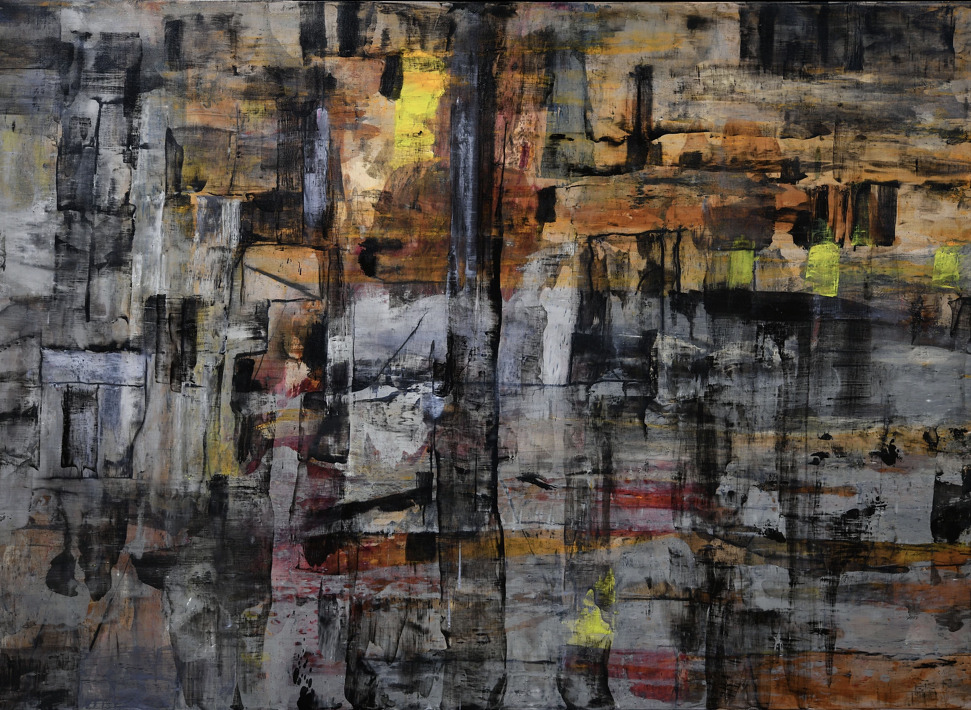
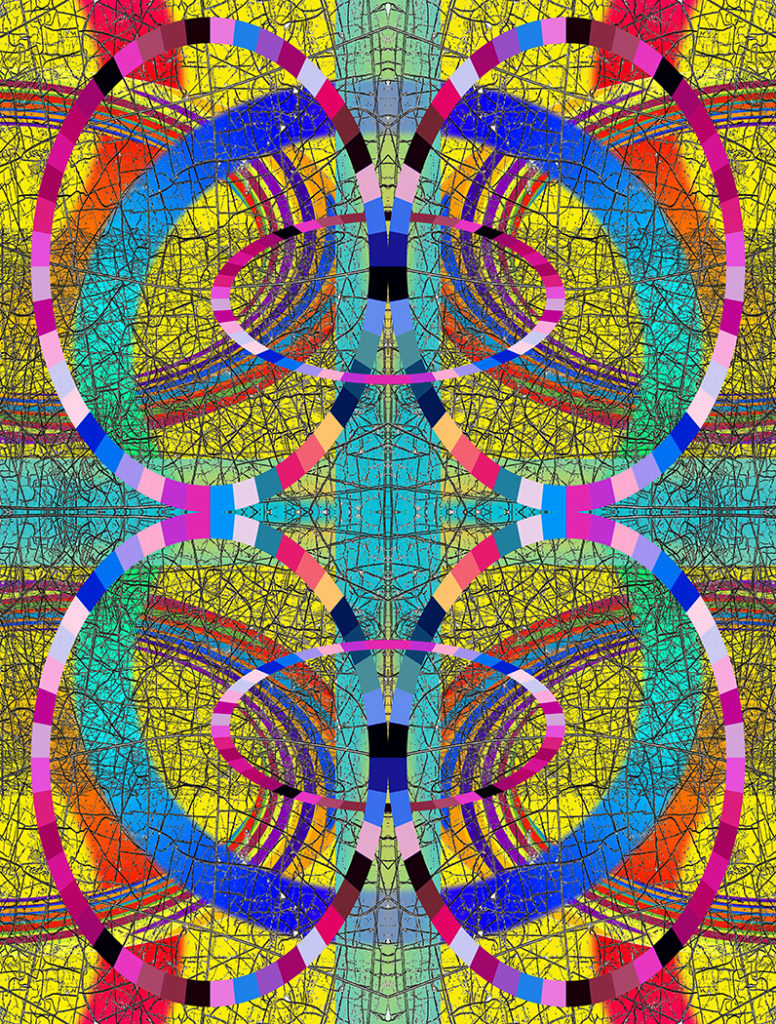
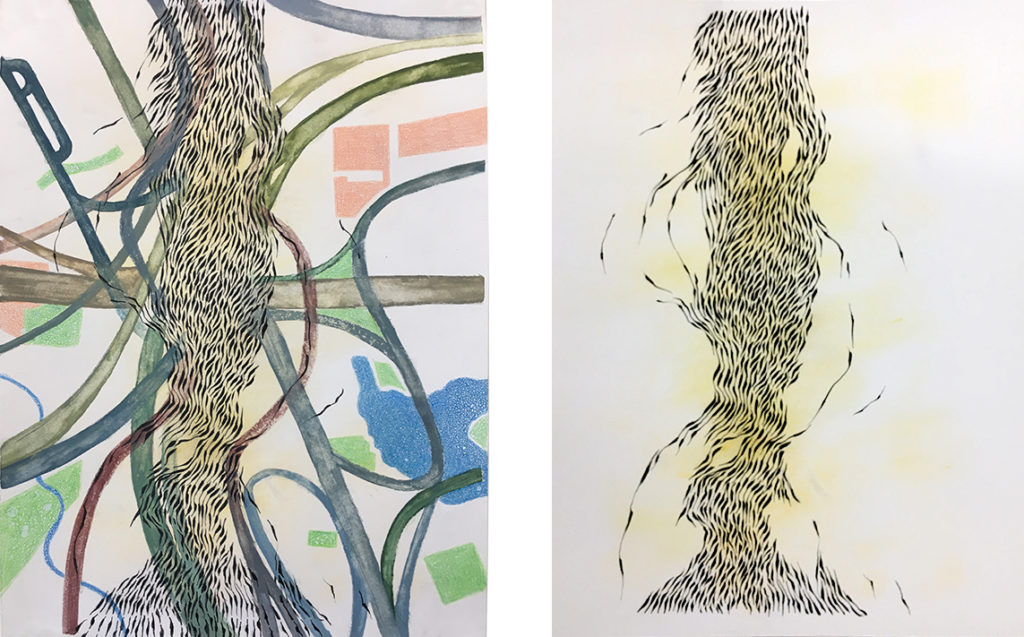
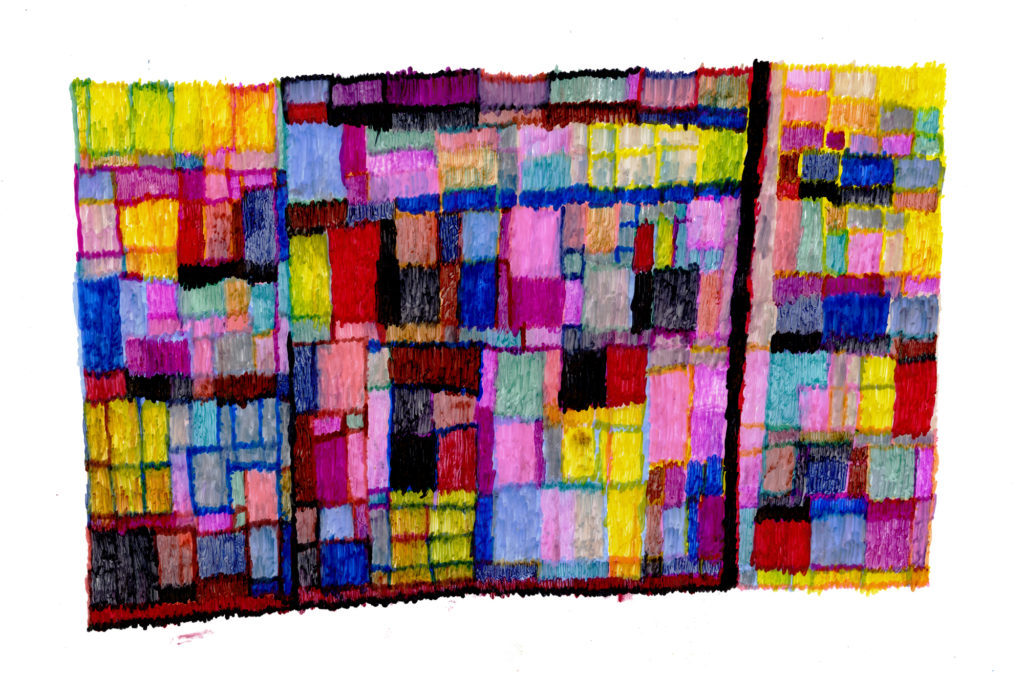
Robert Brinker” is the first solo show of paintings by Robert Brinker to be held at Francis M. Naumann Fine Art.  The eight large paintings and smaller studies in this exhibition were produced over the course of the past year, but they mark the culmination of a ten-year exploration of integrating figurative elements derived from the print media and translated into abstract patterns.  The artist described the process employed in making these new paintings: “I begin by tracing lines from many sources such as coloring books, comics, and traditional Chinese paper cuts… The finished collage is then scanned into the computer where I can further manipulate it… I use these lines as a template that I overlay on some of the original source materials and begin to create the composition, colors and details… In the paintings (as opposed to the collages and preliminary studies), I am able to better explore the space by manipulating the paint, creating subtle fades in the lines and backgrounds or through flat fields of color.  ” Francis M. Naumann Fine Art January 13 - February 24, 2012

FRAMING PRESENTATION/SPECIFICATIONS

This floater frame was designed for heavy duty canvases or cradled panels. The artwork is floated in the frame and screwed in from behind. The float can be varied from 1/16" to 1/2" to accommodate any out of square problems the canvas may have. Click to see all of our floater frame options.

Profile: 121

Wood: maple     Finish: 01 clear lacquer


This is our standard profile for works on paper. The frame was designed to accommodate a 1/2" spacer and a 3/4" strainer. For this exhibition the wood selection was maple and the finish white.
Click to see all of our standard frame options.

Profile:    101 
Spacer:   1/2"
Strainer:  3/4" strainer

Wood: maple     Finish: 15 white opaque


M  


Tags: , , , ,

Because we are a manufacturer we often are asked to do special projects. This particular one was very challenging. A customer who specializes in large scale photography prints asked us to make a frame that goes around the corner of a wall. The final frame was 33" high and the length was 61 1/2" on one side and 92" on the other side. The frame was finished in white with matching spacers and strainers for additional support in the back. This is the prototype we made.


Prototype of 90 degree corner frame 61 1/2" x 92" x 33" high


Another challenge is the crating and shipping of these jobs. The customer ordered two frames.  We packaged them individually and made ethafoam corners to protect them. (Ethafoam is an excellent packaging material because it is resilient in nature, giving it recovery characteristics as well as cushioning protection against repeated impacts.) We shipped them together on a very large custom made crate and palette. Click on the images to see more detail. 


Packaging and Crating of two 90 degree corner frames


One of our recent projects was to make frames for The Baltimore Museum of Art's "Print by Print: Series from Dürer to Lichtenstein" exhibition. In doing research on the exhibition I noticed the funding came because of the collaboration the museum did with the students from The Johns Hopkins University (JHU) and the Maryland Institute College of Art (MICA). Since funding has become much more of an issue in these days of reduced budgets, this caught my attention and I wanted to find out more about the collaboration. I was also interested in sharing with our readers a behind the scenes view of the making of an exhibition. On Friday November 18, 2011 I met with Rena Hoisington, BMA Curator & Department Head of the Department of Prints, Drawings, & Photographs, Alexandra Good, an art history major at JHU, and Micah Cash, BMA Conservation Technician for Paper. 

Karen Desnick, Metropolitan Picture Framing
I was especially intrigued about the funding of this exhibition and the collaborative aspects with the students of The Johns Hopkins University and the Maryland Institute College of Art.  Can you elaborate on the funding source and how the collaboration worked?

Rena Hoisington, BMA
I submitted a proposal for organizing an exhibition of prints in series a couple of years ago.  Dr. Elizabeth Rodini, Senior Lecturer in the History of Art Department at The Johns Hopkins University and the Associate Director of the interdisciplinary, undergraduate Program for Museums in Society, then approached the Museum about working on a collaborative project that would result in an exhibition.  We have worked on collaborative projects with Elizabeth in the past, but this time she wanted to do something more ambitious and apply for a grant from The Andrew W. Mellon Foundation.  We turned in a draft of our grant application and the Mellon Foundation was so enthusiastic about the project that they encouraged the Program in Museums in Society to apply for a larger multi-part grant.  We submitted that grant application in October 2010 and we found out that we received the grant in December 2010. The class started the first week of February 2011. We turned around this whole project in one year, which was amazing.

Karen Desnick, Metropolitan Picture Framing
A project of this size normally would take how long?

Rena Hoisington, BMA
It depends. We like as much lead time as possible. For most loan exhibitions you want at least 4 or 5 years.  This exhibition fortunately was drawn entirely from our collection because we have such strong holdings of western prints (nearly 60,000), ranging from the late 15th century up to the present. In an ideal world we would have liked to have had two years to do this exhibition. Because of the collaborative nature of the project, we didn't have an objects list until May, and then Micah had to frame more than 300 prints over the summer, which is a tight schedule.

Karen Desnick, Metropolitan Picture Framing
Let me turn to you for a moment Alexandra. How did you get involved? And can you talk about what the process was like?

Alexandra Good, JHU
When I was selecting my classes I read the description and had no idea what I was getting into until I came. I was pleasantly surprised. I didn't expect to have so much hands-on involvement. It was really an eye opening experience to see how everything works. The first 2 weeks we did a very fast overview of all the techniques of printmaking. We were then each assigned a different series that we researched. We then wrote the labels for each series. We also dealt with potential themes, marketing ideas, and educational programs. Finally, we all sat down and submitted a list of which series we would like to be in the exhibit.

Karen Desnick, Metropolitan Picture Framing
The themes were interesting to me. There are nearly 60,000 prints in the collection. How did you narrow the section to 350 prints and six themes?

Rena Hoisington, BMA
Before the class started I had chosen 64 complete or almost complete series from the collection and those were the ones that were up for consideration in the class. In the class we tackled a century of printmaking per week except for the 20th century, which we broke into two halves. Each week I would assign the students a series and send them a checklist in an email.

They would come in and see the prints in the study room and write an informative and concise label of 100 words. They gave a 10 – 15 minute presentation and suggested a possible theme. From the beginning we thought it would be more interesting to combine old master, modern and contemporary series. In the beginning I gave the students a possible list of 5 – 10 themes. The students came up with great ideas. Several of the themes in the show – especially "Design" and "Places: Real and Imagined" – came from the students. It was very much about brainstorming. After we had gone through all the centuries of print making, we met with different people in the museum so the students could get a better sense of the collaborative nature of organizing an exhibition. The students then turned in their ideal checklists. They had to choose 35 series organized according to 5-10 themes. I collated those lists as best I could and we had two very long class discussions to arrive at the final list of 29 series organized according to 6 themes.


Note: the themes and artists in the exhibition are:

ImaginationYukinori Yanagi , Ed Ruscha , Kurt Seligmann , Max Klinger , Giovanni BattistaTiepolo, Marcel Duchamp 

Narrative: Louis Marcoussis, John Martin, Odilon Redon, Albrecht Dürer, William Hogarth 

Design: Sonia Delaunay, El Lissitzky, Hans Collaert, Johann Theodor de Bry, Italian 18th or19thCentury

Places: Real & Imagined: Andrew Raftery, Giovanni Battista Piranesi, Julie Mehretu, LudovicNapoléon Lépic, Canaletto

Appropriation: Sherrie Levine, Roy Lichtenstein 

War: Daniel A. Heyman, Pablo Picasso, Fabius Lorenzi, Augustin Coppens, Robert vanAudenaerde, Dutch 17th century after Jacques Callot

Alexandra Good, JHU
It was really interesting because there were certain things I put into a theme and other people had in totally different themes. It was a unique way to see how everyone interprets things differently. I think that is how we got some original themes like "Places: Real & imagined". 

Karen Desnick, Metropolitan Picture Framing
Then what happens?

Rena Hoisington, BMA
As of May we had the checklist. So Micah started working on all of the matting and framing.

Micah Cash, BMA
Many of the works had never been exhibited before. Each individual piece had to be measured and then taken into account the series they were in to come up with options for exhibiting. I would then present those ideas to Rena. Some would fit into standard frames but there were a number of prints that required custom frames. We ended up having 4 different colors of frames in the exhibition. I spent about month and a half coming up with possibilities to let Rena know what was and was not possible. For example, if none of these are going to fit in my standard frames, we have to purchase. And that opens up the idea that now we can go outside the normal colors that we have. I can fit all of these in a standard frame but I don't think it will look good. So then we have to weigh if we go for the cost of purchasing something new. We then would pull out one series at a time and talk about it and come to a conclusion and then sleep on it. After that I guess we made one or two changes before I ordered the frames.

Rena Hoisington, BMA
I loved it when Micah told me that for two Picasso prints The Dream and Lie of Franco: "I want these to be modern but with that color of the paper I have to make them look old master with the wall."

Micah Cash, BMA
The paper was so dark that if we put them in black it really just didn't look right.

Karen Desnick, Metropolitan Picture Framing
These are the little details that people don't appreciate that you obsess over. Okay, the framer is busy working. What other aspects did you need to address?

Rena Hoisington, BMA
There were multiple things. All the students had brainstormed talking points with Anne Mannix, our Director of Communications so she could prepare the PR materials for the exhibition. I also needed to meet with different people in the Department of Marketing & Communications to talk about the advertisements for the show.

We also met with Preston Bautista, Director of Public Programs, to brainstorm programming possibilities.  From this discussion we decided to have a panel with two of the contemporary artists Daniel Heyman and Andrew Raftery. More than 200 visitors attended the panel discussion, which was held on December 3.

We also worked closely with our Department of Exhibition Design & Installation – especially with Karen Nielsen, Director of Exhibition Design & Installation. She is always brilliant in terms of transforming the Thalheimer Galleries.  It was really hard to come up with a color that would complement all of that material. She was the one who picked that color.  Because we knew we couldn't use for example bright white because it would just kill the old master prints. She came up with a custom mix of kilim beige, lightened with a little bit of white. It is custom mixed for us and it is perfect, absolutely perfect.

We then started working on the floor plan. With the wall we wanted to have enough room to break up the series but we didn't want the installation to feel like a maze. We thought about sight lines and how you would take each series in its entirety, as well as each print individually. I basically worked with the floor plan I had used in "Looking through the Lens" a photography show we did in 2008 because I liked that floor plan a lot. I started with that and plugged in the series the students and I had selected. We also had to figure out what series would play well together. For example, Imagination has the Ruscha and the Tiepolo and they would not go well side-by-side. 

Over the summer, two of the students from MICA, Nick Simko & Jennifer Tam, produced four interactive educational programs about different aspects of the exhibition. This will help shed more light on certain works in the print series that we couldn't go into with 100 words on the label. Nick has one program comparing the Apocalypses of Albrecht Dürer and Odilon Redon and one program comparing William Hogarth and Andrew Raftery. He was actually able to go to Providence and meet Andrew Raftery and do an interview with him. Jennifer did one on contemporary printmaking and she was able to go to Philadelphia and meet Daniel Heyman. She actually transcribed all of the text on the eight drypoints in The Amman Project the testimony of several former detainees from Abu Ghraib prison. She also did a program on different printmaking techniques which is going to be invaluable for people. It has still photographs and three films demonstrating different techniques.

The Apocalypse of Dürer and Redon
The Prints of Hogarth and Raftery: A Comparison
Contemporary Printmaking
Printmaking Techniques 

While this was going on Tom Primeau, Director of Conservation was treating some of the works. He also did the hinging for all of the prints.

Micah Cash, BMA
Because of space limitations most of the hinging took place in the paper lab. The mats would be cut, put on a cart, and wheeled down the hall. Tom would hinge them and give them back at the end of the day and I would frame them the next morning. 

Rena Hoisington, BMA
And then there were the labels. I was working with all the drafts. The students went through two drafts of all of the labels. I was deciding on which one to use. I went in and copy edited all of them.  Some I could leave almost as is, some I did a little tweaking, and some I did more rewriting. I wanted to preserve the students voice but have a little more consistency. The labels then go through a whole list of people. They went to Linda Andre, Manager of Teacher Programs & Resources; to Frances Klapthor, Registrar and Associate Curator for the Art of Asia, who checks all of our information to make sure titles, dates, medium, and credit lines are correct; to Anne Manning, Deputy Director of Educationand to Jay Fisher, Deputy Director for Curatorial Affairs and Senior Curator of Prints, Drawings & Photographs for a final review.  They come back to me and I then give it to Vicki Kaak, Graphic Design Manager, who does the labels.

Note: Labeling is an important topic, since some studies have shown that gallery visitors can spend more time reading the labeling than looking at the pictures themselves. The following is an example of a label that is used in the exhibition.

Albrecht Dürer
German, 1471–1528

The Apocalypse

c. 1496 –1498, printed 1511 16 woodcuts

The approach of the year 1500 (the half millennium) raised fears that the end of the world was at hand. During those same years the young Albrecht Dürer created a group of book illustrations that would prove to be one of the most influential series in the history of printmaking. His inspiration was the concluding book of the Bible, often called “The Apocalypse of Saint John” or the “Book of Revelation,” that foretold the events of the second coming of Christ. (“Apocalypse” is the Greek word for “revelation” or “unveiling.”) The Apocalypse was the first book to be designed and published by an artist. Dürer also broke with earlier book conventions in that he entirely subordinated the text — printed on the reverse of each sheet — to his illustrations, each clearly marked with his large and distinctive monogram. Not only did the technical virtuosity of these woodcuts elevate the medium to an unprecedented level of sophistication, but Dürer’s pictorial inventiveness and imaginative envisioning of the text set theiconographic standard for how “The Apocalypse of Saint John” would be illustrated for years to come.

Gift of Blanche Adler, BMA 1929.17.12.5, 1929.17.12.11, and 1934.48.1, and Garrett Collection, 1946.112.5845-5848, 1946.112.5850-5855, 1946.112.5857, and 1946.112.8106-8107

Karen Desnick, Metropolitan Picture Framing
You've had a very busy summer. And after all that is done and it is hung on the wall you have to advertise it. You, obviously, get involved with meeting with donors, funders, and members. What kinds of activities do you do?

Rena Hoisington, BMA
We have a press preview, special preview days for our members, and a council opening for our upper level donors. It was great because six of the students came back and wore special student curator buttons to answer questions about the class and their involvement in organizing the exhibition at two of our opening events.  Alexandra was at both. Do you want to talk about the differences in the council opening Saturday night and the members opening on Sunday afternoon?

Alexandra Good. JHU
A lot of people like I expected wanted to know how the class worked, my involvement, my thoughts on the process. The next day people came in who knew printmaking very well asking me intense technical questions and I was kind of taken aback. I wasn't expecting that. There were really knowledgeable people. Questions that we had no answers for such as the type of pigments used. It was interesting. Everyone was very curious to talk to us.

Karen Desnick, Metropolitan Picture Framing
What will you do differently after you've had this class?

Alexandra Good, JHU
I'm a senior and I have never had a class like this.  I've taken a ton of art history classes. I've seen slide by slide but having the experience of being able to work with things up close at the museum and being able to see the final project was a totally new experience for me. I really hope they do more classes like this. Knowing this, I have a totally new appreciation for every exhibition I see. It's a new perspective when I walk through a gallery. Lighting I never thought about. Wall color I never considered. I remember coming in and talking to Micah about the frame colors. All these tiny details I had never considered.

Karen Desnick, Metropolitan Picture Framing
Rena, what have you learned from the students?

Rena Hoisington, BMA
It was nice for me because I have not taught a class since 2000 at SUNY Stony Brook.  It was great to get my head back into teaching. I really love seeing the arc of the class from beginning to end.  I love seeing the students get excited about the material and build on their knowledge. When we were looking at the prints in the study room, the questions that came up, the points the students made, was a learning experience for me.  I was so impressed with the different ideas for the themes and the different ways they connected the work. Before the show opened, it was a thrill to walk some of the students in and see their faces.

Alexandra Good, JHU
It was really cool to see our work actualized. I hadn't seen it all summer. I knew what prints we were using and I knew our labels but I had no idea what it would actually look like. It was probably a week or two before the actual opening I got to come in and see it. It was unbelievable to see it up there – really great.

Albrecht Dürer’s series The Apocalypse (left) with Odilon Redon’s  portfolio Apocalypse of Saint John

Students in involved in the exhibition are: 

Alexandra (Ali) Good, JHU, history of art
Sofia Iaterola, JHU, history of art and international studies
Meaghan Lavin, JHU, history and history of art
Michele Ly, JHU, molecular and cellular biology
Cassandra McClure, JHU, mechanical engineering
JuWon Park, JHU, history of art and international studies
Hayley Plack, JHU, history of art and museums & society
Nick Clifford Simko, MICA, art history, theory, and criticism / curatorial concentration
Jennifer Tam, MICA, art history & painting / curatorial studies & book arts
Christie Young Smith, JHU, art history and psychology

Print by Print: Series from Dürer to Lichtenstein
October 30, 2011 – March 25, 2012
Baltimore Museum of Art


Tags: , , , , , , , ,

Portrait of Sully De Vito 1928 pencil on paper 15 7/8 in. x 11 1/4 in Arkansas Arts Center Foundation Collection: Gift of Will and Elena Barnet, New York A Peaceable Kingdom 1946 watercolor on paper 9 7/8 in. x 11 3/4 in. Arkansas Arts Center Foundation Collection: Gift of Will and Elena Barnet, New York
Whiplash 1958 pencil, watercolor on paper 8 1/8 in. x 6 1/8 in. Arkansas Arts Center Foundation Collection: Gift of Will and Elena Barnet, New York E. D. Poem 1989 charcoal on paper 27 3/4 in. x 37 in. Arkansas Arts Center Foundation Collection: Gift of Elena Barnet, New York
Art by Will Barnet © Will Barnet, courtesy Alexandre Gallery, New York.
Photography, Cindy Momchilov, Camera Work, Inc.

'Will Barnet at Arkansas Arts Center: A Centennial Exhibition"

October 7, 2011 – January 15, 2012

The Arkansas Arts Center will display more than 75 drawings given to them by the artist in honor of his long-time friendship with former director Townsend Wolfe.

Will Barnet
As a student Barnet studied at the School of the Museum of Fine Arts, Boston. In 1930 Barnet continued his studies at the Art Students League of New York, beginning his long association with the school where he concentrated on painting as well as printmaking, In 1936 he became the official printer for the Art Students League. There, he later instructed students in the graphic arts at the school. Barnet continued his love of teaching with positions at the Cooper Union, at Yale University, and at the Pennsylvania Academy of Fine Arts. He has taught artists including Cy Twombly, Tom Wesselmann, Eva Hesse, James Rosenquist, Mark Rothko and Donald Judd. A devoted printmaker, and with a technical expertise encompassing lithograph, woodcut, serigraph, and intaglio, Barnet has treated printmaking as a serious undertaking in its own right. His work has entered virtually every major museum in the United States including: The Metropolitan Museum of Art, The National Gallery of Art, The Museum of Modern Art, New York, The Whitney Museum of American Art, and The Museum of Fine Arts, Boston.

Arkansas Arts Center
The Arkansas Arts Center was created in 1960. It was decided to select drawings as the collection's primary concentration believing they could make a unique contribution to the field. The Arkansas Arts Center has been committed to building a collection of unique works on paper, primarily American and European, from the Renaissance to the present. Arkansas Arts Center

Framing presentation/specifications

Profile: 106 Wood: Maple Finish: 01 clear lacquer

Optional Components:
3/4" strainer
8 ply Rising antique white mat
UV plexi
coroplast backing

Tags: , , ,


Print by Print: Series from Dürer to Lichtenstein is on view from October 30, 2011 – March 25, 2012. It is an exhibition of more than 350 prints by American and European artists working in series from the late 15th through the 21st  centuries, including Canaletto, Marcel Duchamp, Pablo Picasso, and Ed Ruscha. The exhibition presents a rare opportunity to view 29 series of multiple images in complete sets—revealing the true vision of the artist, print by print. 

From Albrecht Dürer’s 16 woodcut illustrations for The Apocalypse (c. 1496-1498) to Roy Lichtenstein’s seven Monet-inspired color lithographs and screenprints Haystacks (1969), Print by Print demonstrates how serial printmaking has been a vital practice for artists to explore styles, subjects, and techniques for more than 500 years. The exhibition draws from the BMA’s renowned print collection to explore six broad themes—narrative, design, places, imagination, appropriation, and war. These series show a wide range of printmaking techniques, from etchings and engravings to lithographs and screenprints, and vary considerably in number and scale from Picasso’s two compelling images for The Dream and Lie of Franco (1937) to Sonia Delaunay’s 40 brilliant color stencils in Compositions, Colors, Ideas (1930).

All of the series, portfolios, and sets of prints in the exhibition are from the BMA’s collection of more than 65,000 works on paper, including drawings and photographs, from the 15th century to the present. Considered one of the most significant collections of works on paper in the country, it is also a comprehensive resource for the study of Western printmaking. More than half of the works in the exhibition have never previously been on view at the Museum.

Print by Print is the culmination of a collaboration between the BMA and the Museums and Society program at The Johns Hopkins University. The works and themes were selected by students participating in JHU's Spring 2010 course: “Paper Museums: Exhibiting Prints at The Baltimore Museum of Art.” Rena Hoisington, Curator of Prints, Drawings & Photographs, worked with students to select and write labels for the series on view. In addition to selecting the objects, two students worked with the BMA over the summer to develop educational materials for the exhibition.

Tags: , , , ,

One of the exhibitions we worked on this summer is the Harry Callahan exhibition for the National Gallery of Art (NGA). Because the NGA is one of my favorite museums, I started to do a little research on the photographer and the museum. The exhibition marks the centenary of his birth (1912 – 1999). It is on view in the West Building of the NGA from October 2, 2011 – March 4, 2012. www.nga.gov/callahan

Harry Callahan was born in Detroit. He began to photograph in 1938 and was self taught. His talent was immediately recognized. In 1946 László Moholy-Nagy hired him to teach at the Institute of Design in Chicago. There and at the Rhode Island School of Design (RISD) he taught generations of younger photographers. The exhibition of some 100 photographs explores all facets of Callahan's art, from its genesis in Detroit in the early 1940s and its flowering in Chicago in the late 1940s and 1950s to its maturation in Providence and Atlanta from the 1960s through the 1990s. 

NGA photography collection  This could not have a better story.  In 1948 Georgia O'Keefe visited the museum to determine where she was going to donate Alfred Steiglitz's photography collection. One year later she donated 1311 works which became the beginning of the NGA's photography collection.  "Stieglitz worked for the recognition of photography as a fine art—the National Gallery means something in relation to that."  We all owe a debt of  gratitude to these two pioneers of fine art.  In fact,  Sarah Greenough, the Senior Curator of Photographs at the National Gallery of Art, Washington, has just written "My Faraway One: The Letters of Georgia O’Keeffe and Alfred Stieglitz".

The NGA  now has 10000 photographs in their collection. A separate department of photographs was established in 1990. Among the greatest strengths of the collection are groups of photographs by several major twentieth-century American practitioners: Paul StrandAnsel AdamsWalker EvansFrederick SommerRobert FrankHarry CallahanIrving Penn, and Lee Friedlander. Modeled after the Stieglitz collection, each of these holdings include works from throughout the photographer's career and illustrates all aspects of the artists' contributions.

Videos and podcasts
The NGA has a feature on their website that has videos and podcasts about all aspects of their collection from conservation, to talks on individual artist's work, to exhibitions. The viewer gets to meet the conservators, curators, and collectors that have and continue to contribute to this wonderful institution.  It is art history at it's best. www.nga.gov/podcasts/index.shtm


“Wherever he goes, Webb always winds up in a Bermuda-shaped triangle where the distinction between photojournalism, documentary and art blur and disappear.” Geoff Dyer

I first became familiar with the Stephen Daiter Gallery in 2002 when I made a sales trip to Chicago. They have since become a customer. If you love photography and are in Chicago, the Stephen Daiter Gallery is a must stop on your itinerary. They are considered one of the premier photography galleries in the country and this exhibition is one I wouldn't miss. Alex Webb will be at the opening September 9th.  

All images copyright Alex Webb courtesy of Stephen Daiter Gallery


   Alex Webb 

A professional photojournalist since 1974, Webb has crafted an astonishing body of images over the last few decades. Working often in the vibrant colors of the developing countries, Webb has amassed for his viewers an unusual array of fresh entry points, allowing us into a world we are usually kept out of – used as we are, to seeing it recorded in familiar and clichéd images of more ordinary reportage. Avoiding the large “evening news” statements, Webb chooses to make complicated pictures of complicated situations which remind us that there is beauty, mystery and otherness to these peoples and these lands and homes. From a laughing wrestling match under a Havana street lamp to a neon-shrouded popcorn stand seaside in Greece to a mysterious shadow-filled side street in Istanbul, Webb takes – in a second – an image whose psychological texture and formal composition could stand comparison with that of historic oil painting. Beside their contributions to cultural insight, Webb’s prints are objects of striking formal beauty where deceptive geometry, human temperament, and radiant colors combine to create one man’s unmistakable art.

Widely traveled and with countless exhibitions, (and with armfuls of awards that include the Guggenheim), Webb is at the top of his form as he looks back over thirty years in this upcoming exhibition and publication, whose title was provided by the great poet and thinker Goethe.

Stephen Daiter Gallery

Stephen Daiter Gallery offers fine and vintage examples of important American and European photography from the 20th century. Their areas of specialty are avant garde, experimental, documentary and photojournalism. They include the Chicago School of Design, the Bauhaus, the Photo League, and the André Kertész Estate. 

Daiter Contemporary presents recent work by young, as well as established mid-career artists.


Tags: , , , ,

We recently met Michael and his wife Elizabeth when they came to our production center to pick up their frames for their upcoming show at the Gruen Gallery in Chicago. Bentley has been a customer since 2003.  He is a very accomplished artist and he clearly was not afraid to tackle a large scale framing project. All of the frames were oversize with the largest 48" x 96".   The Bentley's were in Wisconsin visiting family. They were going to personally drive the framed artwork to their gallery in Chicago. They are used to being on the road. They have homes in Nova Scotia, Canada and Santa Fe, NM. Beautiful settings for inspirations for his landscapes.

The show opens Friday September 9th at the Gruen Gallery in Chicago. gruengalleries.com  michaelbentleystudio.com 


Tags: , , , ,


                   copyright Brian Ulrich

It has been a busy summer. One of the projects we were working on was the Brian Ulrich exhibition at the Cleveland Museum. After looking at these images,  I share Brian Ulrich's opinion about our consumer society and the excess and waste it creates. A reminder to all of us why photographers are important and how museums help the rest of us understand why. The following is the Cleveland Museum's description of the show. 

The Cleveland Museum of Art presents the first major museum exhibition of contemporary photographer Brian Ulrich’s work from a decade-long examination of the American consumer psyche in Copia—Retail, Thrift, and Dark Stores, 2001-11. From the Latin word for “plenty,” the artist’s Copia series explores economic, cultural and political implications of commercialism and American consumer culture. The exhibition, featuring almost 60 photographs, will be on view from August 27, 2011 to January 16, 2012 in the museum’s east wing photography galleries.

“I had to see if people were indeed patriotic shopping in response to the events on September 11th,” says Brian Ulrich, photographer, referring to the beginning of his decade-long investigation. “Not only was it clear that this was the case, but standing in a big box store or shopping mall, I could see the entire trajectory of the 20th century economy and ideology playing out in the excess of goods and overwhelmed stares of the shoppers. Ten years later, I hope that these photographs serve to add as a marker in which we can learn about our behaviors, habits, comforts and purpose.”

The body of work in the exhibition, curated by Tom Hinson, the museum’s curator emeritus, is divided into three parts: Retail, Thrift and Dark Stores. For the work included in the Retail phase (2001-06), Ulrich traveled extensively throughout the United States. He initially used a hand-held camera with the viewfinder at waist level, which allowed him to remain anonymous while documenting shoppers engrossed in navigating the abundance of goods found in vast enclosed malls and big-box stores. The second phase, Thrift (2005-08), focuses on thrift stores, the collecting places for discarded and unwanted consumer products, and its workers, as they tried to bring order to the vast amounts of donated, discarded and unwanted consumer products. The concluding group, Dark Stores (2008-11), features images in which Ulrich explores the impact of the 2008 financial crisis with haunting architectural landscapes of abandoned buildings and empty parking lots that have become commonplace in towns across America. Photographs from the Cleveland area are featured in the Retail and Dark Stores sections of the exhibition.

More programming information and details are available at www.ClevelandArt.org.


Tags: , , ,


 “


Ezra Jack Keats papers, de Grummond Children’s Literature Collection, McCain Library and Archives, The University of Southern Mississippi. Copyright Ezra Jack Keats Foundation.       

We always like to know more about the exhibitions we frame. I was not familiar with Ezra Jack Keats's work before we started working with the Jewish Museum on this exhibition. I think you will agree his work is wonderful and it is an exhibition the whole family will enjoy. He has also been honored for his contribution in the civil rights movement. Another example of an artist changing the way we perceive the world. 

The following is the Jewish Museum's description of the show. This is the first major United States exhibition to pay tribute to award-winning author and illustrator Ezra Jack Keats (1916-1983), whose beloved children’s books include Whistle for Willie (1964), Peter’s Chair (1967), and The Snowy Day (1962), opens at The Jewish Museum on September 9, 2011 and remains on view through January 29, 2012. Published at the height of the American civil-rights movement and winner of the prestigious Caldecott Medal, The Snowy Day became a milestone, featuring the first African-American protagonist in a full-color picture book.  The Snowy Day went on to inspire generations of readers, and paved the way for multiracial representation in American children’s literature.  Also pioneering were the dilapidated urban settings of Keats’s stories.  Picture books had rarely featured such gritty landscapes before.

Tags: , , ,

Older Posts »