Metropolitan is a manufacturer of modern wood custom picture frames for museums and galleries.  Our custom picture frames are available in standard, thin, ultra thin and wide profiles in 5 woods, 36  finishes, & 6 depths. Metropolitan also manufactures custom floating picture frames and very deep custom shadowbox picture frames.  Optional components include: custom wood spacers, custom made strainers, custom 4 or 8 ply picture frame mats, custom sized acrylic, and custom sized backing boards to ensure you get all the components you need to present your photographs professionally. All are available in length, cut to size, cut to size with wedges, or joined with or without splines.  See framing advice for step by step instructions and videos.Â
MATTED PRESENTATION
This is the classic presentation where the mat covers the edges of the artwork. It is recommended when the artwork has a border or edges that should be covered. See framing advice for measuring and final fitting instructions.Take the stress out of the calculations with our new online mat calculator.
NON-MATTED PRESENTATION When photographs are not matted it is necessary to separate the photograph from the glazing for conservation reasons. Either plastic, wood, or matboard spacers are used to provide the separation. Whether the frame comes to the image of the photograph or there is a white border left around the image is an aesthetic decision. One of the reasons a white border is left around the image is that the shadow cast by the spacer will be on the white border and not on the photographic image itself. Sometimes the white border becomes a distraction because the photograph has little or no white in the image. In this case, we would recommend framing to the image. If using a 1/4� spacer less of a shadow is cast. See framing advice for attaching spacers/strainers and final fitting instructions.
Most skydiving photography uses wide-angle lenses and fast shutter speeds to freeze time and capture images with the highest possible clarity. In contrast, "Incident Report" uses a lens-less pin-hole camera which does not refract light but instead allows the image to imprint itself directly onto a piece of film over a period of three seconds hereby capturing 500-feet of free-fall at speeds exceeding 150 miles per hour.
Using a pinhole camera I crafted specifically for this project, I have captured one moment from each day in my life. The photos are clustered by month, with a small portion of the negative exposed for each calendar day.
Through photography, found imagery and other media, Adam Ryder presents a new body of work that operates as evidence of a secretive fraternal organization known to its members as “Renovatio Imperiiâ€. Latin for “restoration of the Empireâ€, Renovatio Imperii is purported to be clandestinely involved in geo-political affairs and claims ties to the Roman imperium of classical antiquity. Inspired by the neoclassical architecture of Washington, DC, conspiracy theories and the Masonic brotherhood, Ryder cleverly employs found objects, imagery and manipulated photographs of familiar landmarks in order to build a case for Renovatio Imperii’s existence and their ominous hand in global affairs.
The Marking Time Series (thread and shadow drawings) evolved from an unexpected moment that happened in my studio in Beacon, New York, one day in January of 2013 at 3 o’clock in the afternoon—a precise, haunting intersection of an object (thread), the sun, and white paper. Since that time I have been recording the sun’s shadow in relation to pieces of thread, as photographs and video experiments during the months of January, February and March (from Winter Solstice to Spring Equinox). From this latitude/vantage point, I wait for the sun to draw delicate shadow lines in collaboration with my random placement of thread. Each piece depicts one moment in time, when the sinking winter sun creates long shadows; both thread and sun are the charcoal, ink, pencil.
Susan Ressler is an author, educator and social documentary photographer. She has been making photographs for more than 40 years, and her work is in the Smithsonian American Museum of Art, the Library Archives of Canada, and many other important collections. She has been widely exhibited, both nationally and internationally, with solo shows at venues that include Nexus Contemporary Art Center (Atlanta), Center for Creative Studies (Detroit), Sheldon Memorial Art Gallery (Lincoln, NE) and BC Space, (Laguna Beach, CA) among others. Ressler edited the book Women Artists of the American West (McFarland, 2003), a scholarly anthology on under-represented women artists west of the Mississippi, and was Head of the Photography Area at Purdue University, where she taught photographic practice, criticism and history from 1981-2004
I use computers and printers to explore some of the questions I have about the things I make with cameras. I believe in photography's ability to touch truth, but less so in our placing of importance on it having some kind of indexical relationship to what's "real."
I’m an architectural photographer and a Wisconsinite. The two things have come together in my project about ice fishing. I was and am attracted to ice shacks as objects and to the notion of them as shelter. They are where people go to get away and still be together and they beautifully reflect the idiosyncratic nature of people who willingly walk on frozen water.
My recent photographs began as meditations upon the forms, colors and patterns of marine mollusk exoskeletons found around the world. Neutral backgrounds and shallow space focused attention upon single forms. As my approach to image making evolved, I altered the forms of the shells and placed them in imaginary environments. Gradually, other forms from nature were introduced.
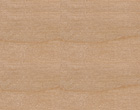
Maple is our most popular wood. It is valued by museums and fine art galleries for its neutral appearance. Metropolitan Picture Framing clear lacquer and stain finishes are semi-transparent, allowing the grain of the wood to show. Our painted finishes are opaque and have seamless corners.
Cherry in its natural state has a light red color which makes the finishes have a depth of color that cannot be achieved on other woods. All woods will change color over time. Cherry gets darker giving it even a deeper concentration of color and grain. The wood is moderately heavy and hard. Cherry like walnut is more expensive than the other wood options we provide.
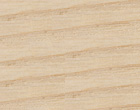
Ash is a very dense wood with a grain pattern that can complement or detract from the artwork. If the grain complements, it is a good choice because it is our least expensive option. Ash will vary in color and is not recommended on the clear and white finishes if consistency is important. It is most popular in our darker wood stains and charcoal and black finishes which will cover the inconsistencies.
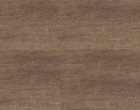
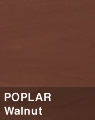
Walnut has a rich dark brown heartwood with a tan colored sapwood. The wood is fairly soft and moderate in weight. It will lighten with age. Darker finishes are often used to cover the color differences in the heart and sapwood.
Basswood is one of the softest woods in the hardwood family. It has virtually no grain pattern. We only offer it unfinished as an inexpensive option for customers who have the expertise to do their own finishing. We do not recommend it for frames that will be reused or exhibited frequently because it easily dents.
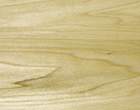
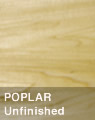
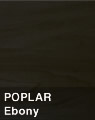
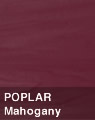
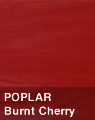
Poplar varies from light cream to yellowish brown, with occasional streaks of gray or green. Poplar is primarily used for painted or dark finished frames because of its color inconsistencies.  Poplar typically has a straight, uniform grain, with a medium texture.  Because Poplar is an inexpensive hardwood it is a good choice when price is a consideration.  Colors tend to darken upon exposure to light.
FINISHES
Call customer service
for free cuttings.
PURCHASING OPTIONS
UNJOINED
JOINED
Uncut Lengths
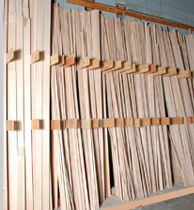
All of our frame profiles can be purchased uncut in lengths. They can be purchased unfinished or finished to order. Lengths vary from approximately 8 to 12 feet (most will be 10′). We will come as close to the footage on your order as possible. Note that UPS will not ship over 8 feet. When ordering you can specify cut 5′ and balance, 6′ and balance, 7′ and balance, etc. On larger orders we normally ship by truck and cutting the lengths is not necessary.
Standard Join
Frames are cut to your specifications, glued, and joined with our wedge system from behind so there are no visible nail holes. All frames are then touched up and sanded before they are finished to ensure the highest level of quality.
Cut to size
Frames are cut to your specifications with mitred corners. This option will require that you have a method for joining the frames. It is commonly used by picture framers and woodworkers who have their own joining equipment.
Matched Splines
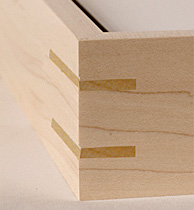
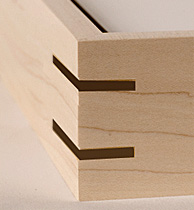
Spline joints are used for additional strength and beauty. Because the spline joint offers a larger glue area, the joint becomes very strong. They are necessary on very large and or very thin frames. Matching splines use the same wood as the frame and are less conspicuous than the contrasting splines. Spline joints are often used with painted white, black and graphite frames to add stability to their seamless corners. With the painted finishes they will not be visible.
Cut to size w/wedges
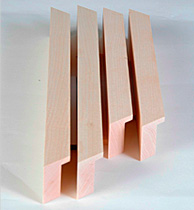
The wedge system makes the joining of wood frames as easy as joining metal frames. The frame comes to you unjoined, but the mitres have been routed out from behind with a special machine. You glue the corners and insert a plastic wedge and use a hammer to insert it into the prerouted slot. This system will allow you to adjust the corners until they are aligned. See framing advice. This option is often used by customers who are ordering large or oversize frames and want to save money on shipping.
Contrasting Splines
Spline joints are used for additional strength and beauty. Because the spline joint offers a larger glue area, the joint becomes very strong. They are necessary on very large and or very thin frames. Contrasting splines are made from a different wood than the frame and are used primarily to complement the overall frame presentation. They are only noticeable on unfinished or lighter wood finishes. This option is less commonly used than the matching splines.
PACKAGING & SHIPPING
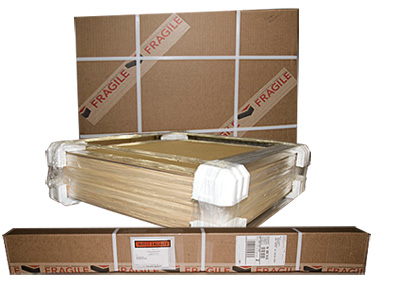
PROFESSIONAL PACKAGING. Plastic wrap or coadhesive is used for protection on all frames. On joined frames cardboard is banded to the top of the frame package for extra protection. Styrofoam corners or angles are put on the top and bottom of the frame package. All packages come in a custom made corrugated box. Boxes are then taped and banded for ease in carrying and additional safety.
SHIPPING ESTIMATES are difficult to give because prices vary by zone, size, and weight. Most orders over $500 that do not require expedited shipping or oversize shipping should not exceed 15% of the order. Note: Although we do not have minimum orders, handling & shipping charges will be high if just ordering one individual frame. This is especially true on larger frames due to UPS oversize charges. To minimize shipping charges on single large frames, we recommend purchasing them unjoined with our wedge system. See framing advice.
Shipping Tips
Item(s) successfully added to cart
What would you like to do next?
Login Successful
You can access your account settings/screens via the My Account menu on top.What would you like to do next?